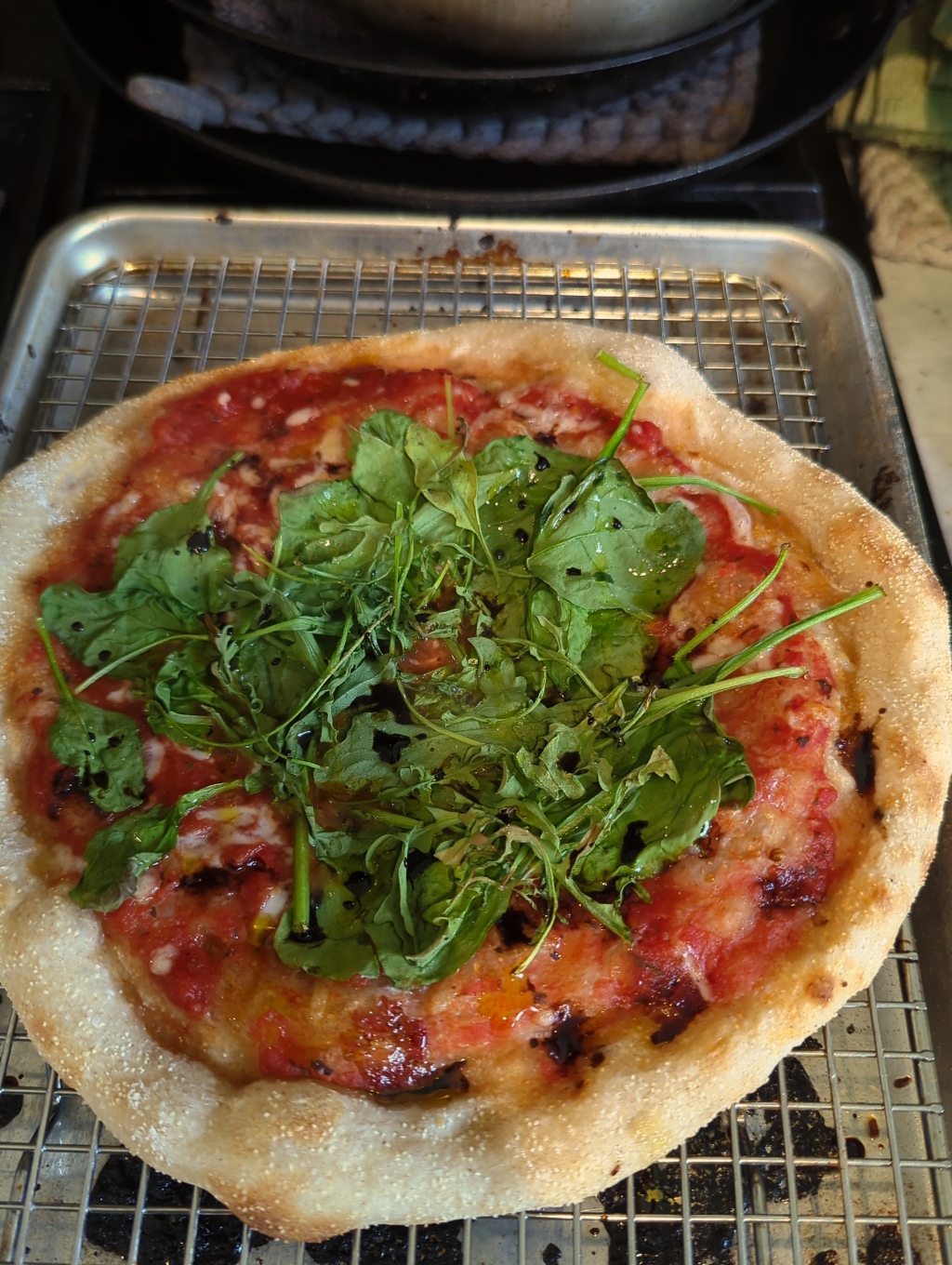
“A crisp crust heard from halfway across the backyard”
Goal
For tonight’s dinner I really wanted to improve my pizza skills. My first attempt at naturally leavened pizza left me with quite a few desires:
Better launch
Better rim
Better bake
The pizza is regular baked in a home oven on a cast iron pizza steel (is it still called a pizza steel?). There is no timer, I go by looks, but if I had to estimate it was about 2 or 3 minutes until I rotated.
Changes
For these pizzas I used 00 pizza flour from King Arthur, compared to my typical sourdough ratio of 50% whole wheat and 50% bread flour.
Hydration was reduced from 80% to 65%.
Countertop was dusted with semolina, while peel was dusted with rice flour.
Shaped dough balls were stored in a small, lightly oiled boil inside of a plastic proofing box in the fridge.
During the bulk ferment I performed four gentle stretch and folds rather than slap and folds.
Observations
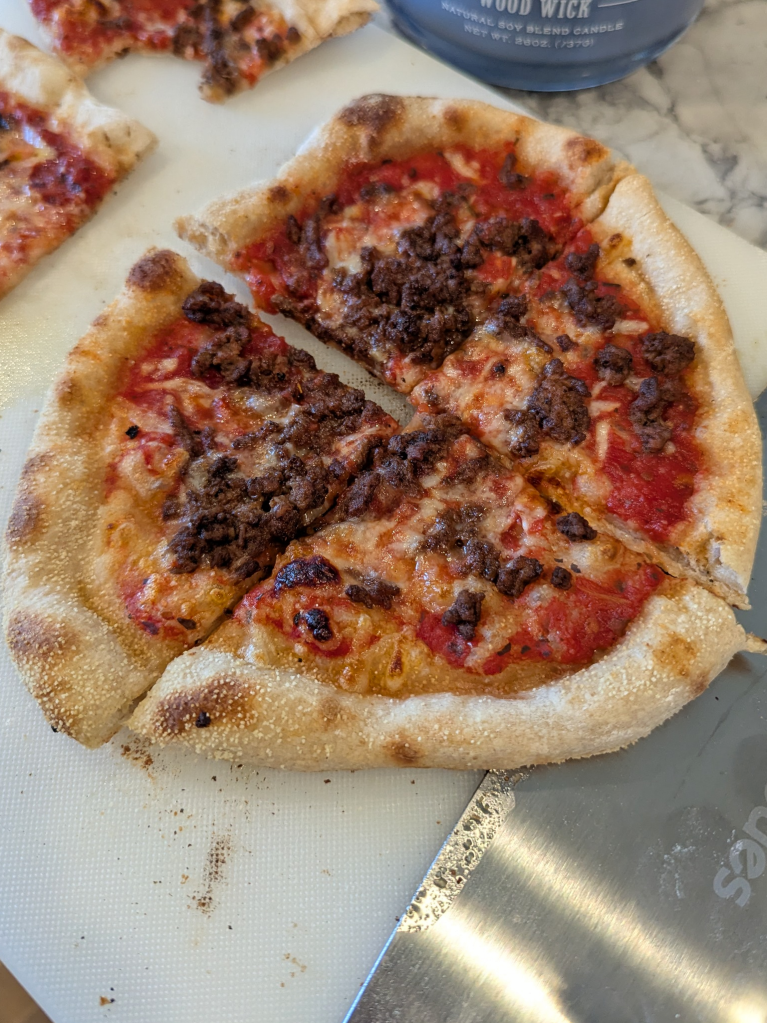
The flour, hydration, and gluten building changes were quite significant. It was a lot to change all at once, but I think this led to a better base to experiment from moving forward.
The dough was silky compared to the bran structure in my typical whole wheat dough. Even after the initial incorporation I couldn’t believe how smooth the dough was.
With the decreased hydration, I had to get accustomed to the new feeling of the dough in addition to the way 00 flour feels when hydrated as well. This took some getting used to. It’s incredible how easy medium-hydration dough is to work with after working with 80% and 85% bread loaves.
Gentle stretch and folds did well to preserve gas building up in the final dough balls. This carried over well through the cold retard. They did not rise as significantly as a warm ferment or multiple-days cold retard but I was more than pleased with the results.
Dough
I just wanted to talk about the dough for a moment. I am used to my standard weekly loaves at 80% hydration, made of 50% whole wheat and 50% bread the dough becomes loose but not soupy. Even when it’s nearing the end of the bulk ferment the dough can still be quite tacky. At the end of the 00 flour’s ferment the dough was just tacky, quite a bit firmer than I’m used to and at the same time more supple.
I am also used to the extensibility of my normal dough so when I stretched it into a window-pane it, obviously, snapped much earlier than I’m used to. This led me to worry if I had developed enough gluten. On a follow up test though a few moments later, I was able to read through the dough so I divided, shaped, and left it to cold ferment.
Discoveries
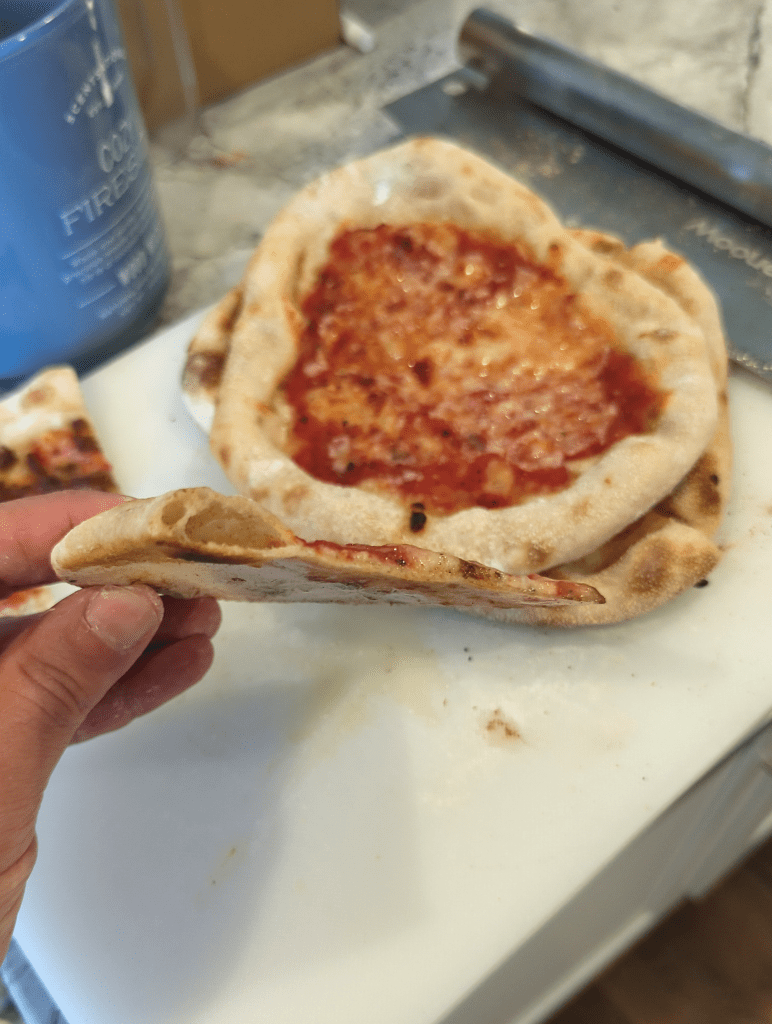
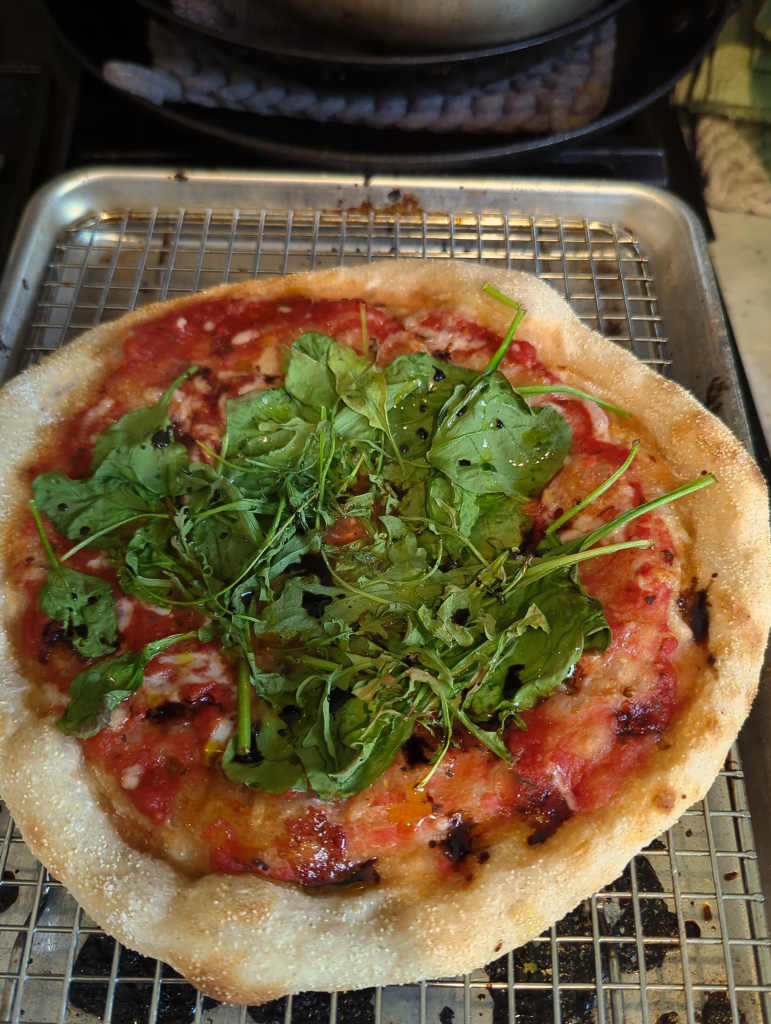
Living in New Jersey, the eminent pizza state, creates certain standards. This pizza, I think, just about hit the mark. Thin and crispy bottom, floppy but not soggy, light crust that wasn’t too chewy.
Keeping the sauce and cheese to a minimum worked very well. The pizza was able to maintain its structure rather than soaking through.
The gentle stretch and folds during bulk ferment I think helped the dough maintain gas as the rims puffed up better and more uniformly than my previous attempt.
Workflow Improvements
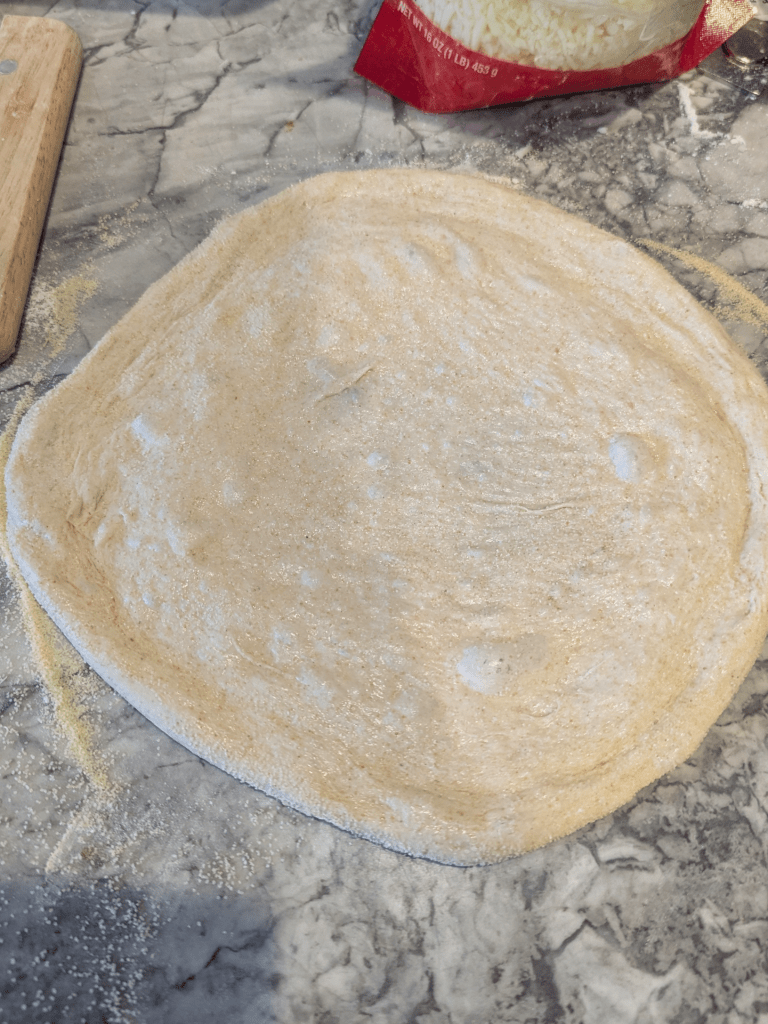
Launches – You’ll notice in the photos that my dough is speckled with semolina. I learned that by dusting the countertop with semolina before opening the dough greatly improved my launches. I also dusted the peel with rice flour, zero sticking.
Cold retard – I stored the dough balls in the fridge for about 24 hours in lightly oiled, ceramic bowls, inside of a plastic proofing box. They puffed up a little bit in that time, but what they didn’t do was spread out into pancakes and bond with each other (you gotta keep ’em separated).
Future Direction
Hydration – I would like to test progressively higher hydration ratios with the 00 flour. Hopefully this might give me a doughier, but still soft, rim.
Opening – I’d like to get slightly thicker crust. I really enjoyed the crispy bottom of these pies but if I could get a bit more substance would be great. This might come down to my opening technique.
Overhead heating – In the previous attempt, I had a stove-top griddle laid across the rack right overhead to provide some more direct heat from above. I think I will revisit that method, but to improve my launches I kept the headspace clear.


Leave a comment